
In traditional life the first emotion the Aborigines cultivate is compassion. For them, the feeling of compassion extends beyond a moral sense, it is the summation of their sympathetic and empathetic sensitivity to the surrounding world.
Sympathy is feeling accord with the emotions of another, whereas empathy is the power to project one’s being into the emotional state of another or to allow another state to enter and be felt. Compassion is Sympathy or Empathy accompanied by a desire to alleviate the plight of another. From compassion flows a group of emotions called public or social emotions.
First Time Teachers
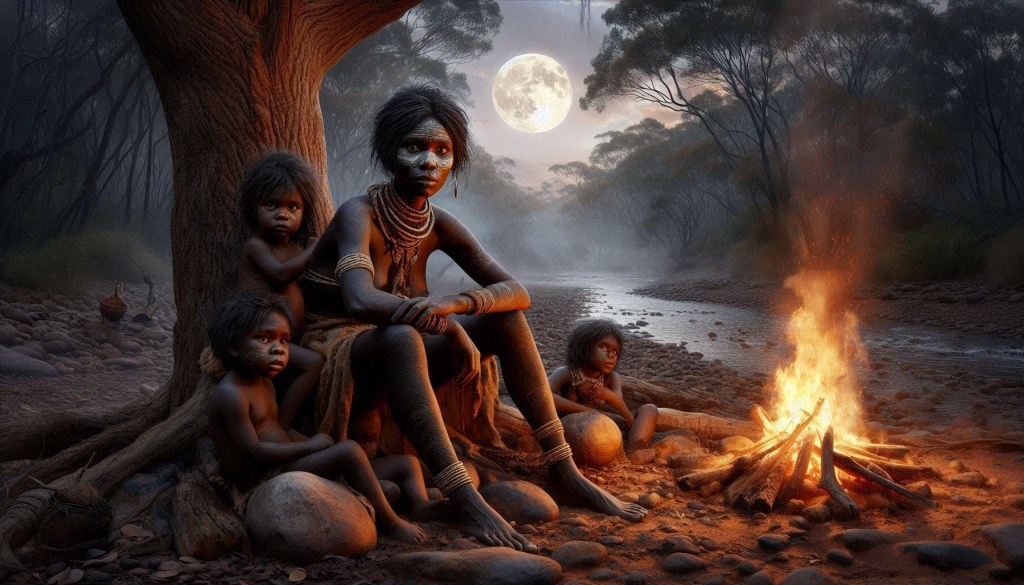
The teaching of compassion begins from the first moment an infant grabs some food or object and brings it to its mouth. A relative, usually female, repeatedly uses these moments to plead with the child to share what it has to her.
This practice continues today. Over my lifetime as the number one babysitter, I would hold my hands up to cover my eyes, pretending to cry after repeated requests. I would peep through the cracks in my fingers and see them holding a chip (potato chips) or fruit in their chubby little hands to offer it to me.
The constant maternal dramatisation of compassion in the early years orients a child’s empathy, support, warmth, and generosity. Reinforcing this constant dramatisation by the mother is an open society in which people actively share everything with each other. The child experiences a world in which compassion and pity are dramatically directed to the temporarily less fortunate.
Any adult that does not show any empathy with the surrounding world is thought to be like “a rock” and “not quite human.”
Compassionate Backfired
I want to share an incident that demonstrates the Aborigines sense of compassion occurred during the Australian Bicentennial celebrations. The Australian Government had the bad taste to commemorate the landing of Captain Cook in 1788 rather than the ratification of the National Constitution which occurred in 1901.
Cook’s landing was, of course not the birth of a nation but rather the beginning of the Genocide of the Aboriginal people.

The Australian Government sponsored an elaborate project for the occasion to re-enact the First Fleet arrival in Sydney from England to coincide in time to celebrate the invasion.
A group of Elders stood on the headlands overlooking Botany Bay, where one of the Fleet would pass. Enacted the “discovery of Australia”, one onlooker half-jokingly said, “You have boys in your community who are strong swimmers, maybe they should sneak out to attach explosives to it and blow a hole in the boat.
One old Aboriginal man shook his head in response, “no, we can’t do that, “because we would have to swim out there and save all those gubbars (white people) from drowning.”
The man sighed and said, “Those are the attitudes that allowed the whites to rape and destroy our people, our land, and our culture. And those are the attitudes that we have to lose.”
The Aboriginal elder smiled and said, “But if I lost those feelings I wouldn’t be Aboriginal. “
My blood turns cold at the thought how the compassionate, humane, and dignified culture of the Australian Aborigines was ripped apart by the blind greed and punishing desperation of a colonist convict mentality, and how the ancient, open spiritual freedom of the Australian continent was converted to a penal colony.

 Geomancy Of Earth
Leave a reply to Satinder Cancel reply